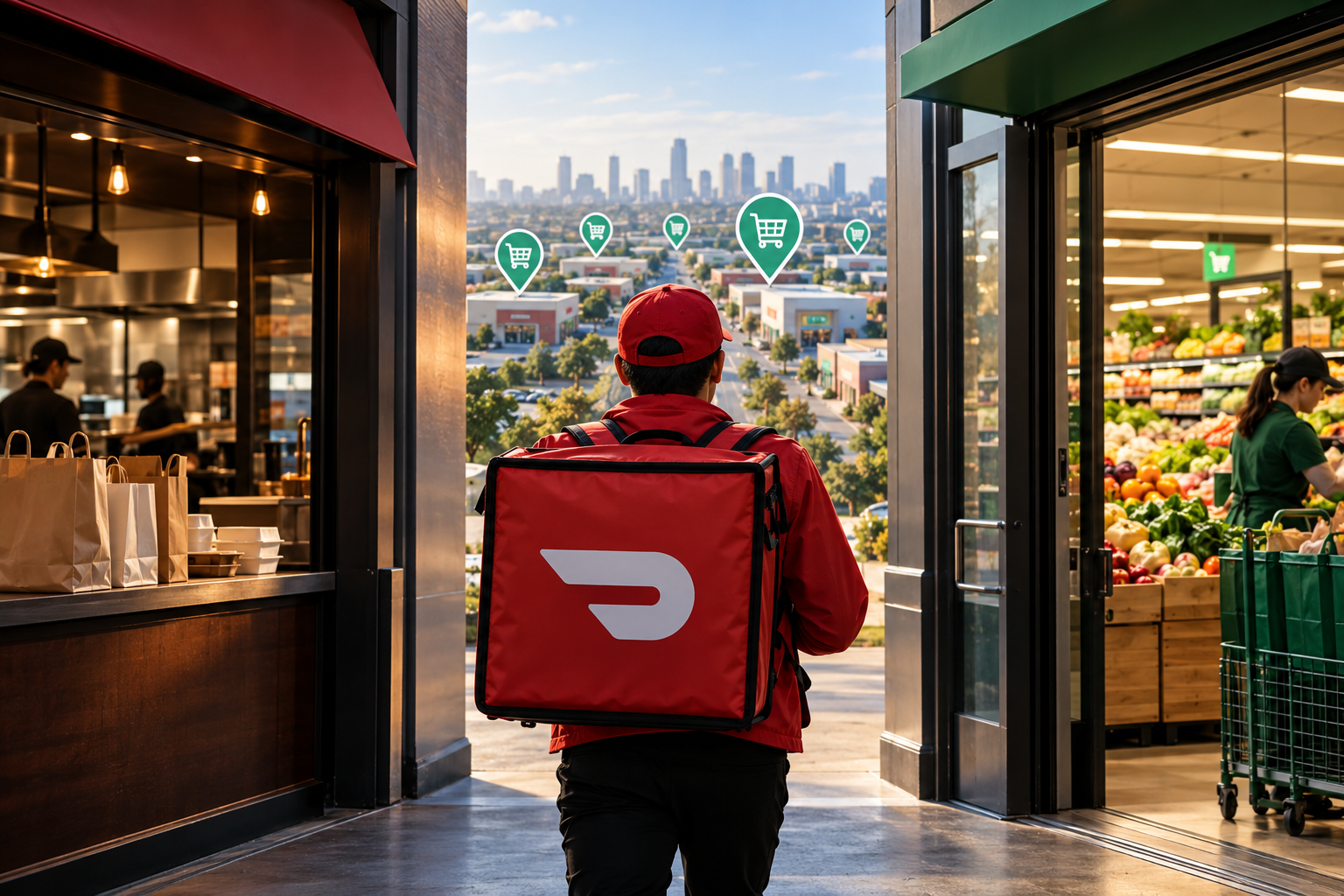
DoorDash’s Instacart Deal Puts Grocery Delivery at the Center of Its Expansion
DoorDash is not simply buying another delivery company. Its $17 billion deal for Instacart pairs a restaurant-delivery footprint with a major grocery network—and makes grocery the clearest test of whether the combined company can turn scale into more useful customer and merchant reach.
The acquisition brings two large delivery businesses under one roof. But the headline price is less revealing than the operating question beneath it: can DoorDash expand grocery access without disrupting the relationships that made Instacart valuable?
The Deal Makes Grocery DoorDash’s Strategic Test
DoorDash has been strongest in restaurant takeout. Instacart brings a broad network of grocery partners, shoppers, and customers.
That combination gives DoorDash a larger position in a category its CEO has described as one of the hardest to get right online. Grocery orders involve more than delivery speed: store selection, item availability, substitutions, shopper execution, and retailer relationships all shape the experience.
The deal therefore is not yet proof of a stronger grocery business. It is a bet that DoorDash can make Instacart’s existing position more valuable without weakening it.
50,000 Stores Is the Proof Point
DoorDash says Instacart customers will gain access to 50,000 additional stores covered by DoorDash.
That is the most concrete expansion claim in the announcement—and a useful test for the transaction. More stores only matter if they create meaningfully better local selection and lead customers to place more orders.
The signal to track is simple: does additional coverage translate into stores customers can actually use, rather than a larger combined directory with limited practical overlap?
A Shared Roof With Separate Front Doors
DoorDash says the Instacart brand and app will remain. Instacart shoppers can continue fulfilling Instacart orders, while grocers can choose to work with Instacart or DoorDash.
That continuity is strategically important. Instacart’s grocery network depends on trust across retailers, shoppers, and customers. Preserving familiar front doors may reduce disruption while the companies combine.
It also creates a constraint. If the brands, apps, and merchant choices remain distinct, DoorDash will need to show where common ownership improves the service. The announcement does not establish how the businesses will share operations, customer demand, or delivery capacity.
Grocers Keep a Choice—and DoorDash Keeps a Burden
Retailer choice protects grocers from being forced into a single delivery identity. It also means ownership alone does not guarantee broader merchant participation.
For DoorDash, the burden is to make its expanded network attractive enough that grocers want deeper engagement across one or both platforms. For customers, the payoff must appear in selection, availability, and dependable fulfillment—not merely in a corporate combination.
CBS News and TechCrunch describe the deal as a union of two major food and grocery delivery networks. That confirms its scale. It does not yet prove financial or operating synergies.
The First Results Must Show Up in Stores and Orders
The next phase will clarify the operating model and the deal’s final terms. The more important evidence will arrive after the platforms begin operating under common ownership.
A practical scorecard has four parts:
- Store access that improves local choice - Grocer participation beyond existing arrangements - Customer usage of the expanded selection - Delivery performance that holds up as grocery volume grows
DoorDash is buying reach. The transaction succeeds strategically only if that reach becomes a better grocery product for merchants, shoppers, and customers.